
Rival Schools: United by Fate
Screenshots
Summary
The core fighting game can be likened to a polygon-based Marvel vs. Capcom title, with a few key distinctions. In terms of controls, it diverges from typical Capcom fighting game conventions by offering only four buttons—two punches and two kicks—mirroring the SNK-style layout rather than the usual six-button setup. Players select a team of two characters and battle against an opposing two-character team. However, the actual combat is one-on-one, with the second team member entering the fray only when a player accumulates enough 'vigor' to initiate a Team Up attack. This is triggered by pressing a punch and kick button with the same strength. Team Up attacks typically involve a coordinated double strike between the main character and their partner, or, in the case of most female characters, provide healing or a vigor boost. After each round, regardless of the outcome, players can choose to continue with the same partner or keep their main character in the next round. The 'vigor' meter, functioning as a super meter, can reach up to nine levels, with Team Up attacks consuming two levels and solo super moves using only one. Similar to Marvel vs. Capcom, all characters have access to universal low and high launchers, enabling air combos. The game also featured a few unique defensive mechanics. Tardy Counters operated similarly to Alpha Counters from Street Fighter Alpha, letting players retaliate instantly while blocking. However, Tardy Counters had fewer limitations—any hard normal, special, or super move could be used, unlike Alpha Counters, which were restricted to specific moves per character. Additionally, Tardy Counters didn’t drain any vigor, unlike Alpha Counters, which required a level of the Super Combo gauge. Attack Cancels let players negate an incoming hit by timing their own attack to meet it, canceling both strikes (though it wouldn't stop the remaining hits of a multi-hit move). Successfully doing so also granted an extra level of vigor.
Storyline
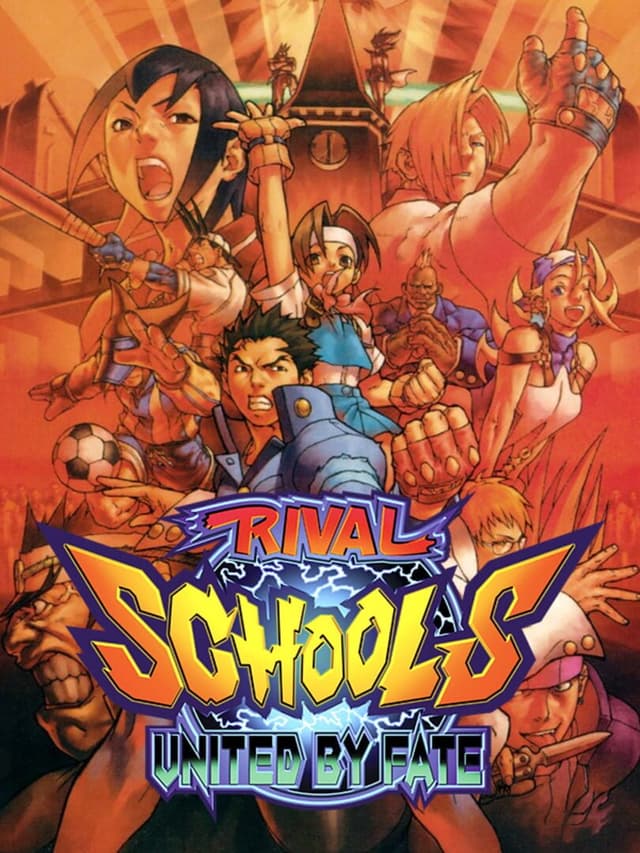
Rival Schools begins in Aoharu City, a Japanese metropolis where local schools are mysteriously attacked and students and teachers are kidnapped. The game follows a group of characters as they investigate the source of these incidents, with story sequences and battles showcasing their relationships with other schools and within their own team. As the plot unfolds, it is revealed that Justice High, an elite institution in the city, is behind the attacks. The player's team ultimately confronts Raizo Imawano, the school's principal and the game's first major antagonist. If specific conditions are met during the battle with Raizo, the story continues into a climactic showdown with Hyo Imawano, Raizo's nephew and the true architect of the game's events. The single-player experience in Rival Schools changes based on character selection. Choosing two characters from the same school (with a few exceptions) leads to a structured narrative, where each fight is prearranged and accompanied by 2D cut-scenes that advance the story. However, if characters from different schools are selected, the mode functions more like a standard fighting game, with the player's team battling random opponents before facing the main boss. In the arcade version, players initially had to select two characters from the same school, with full character freedom unlocked over time. The PlayStation editions, on the other hand, allowed immediate access to all characters without restrictions.
Artwork




Supported languages
| Audio | Subtitles | Interface | |
|---|---|---|---|
| English (US) | ✓ |
Similar games

Alternative titles
- Shiritsu Justice Gakuen: Legion of Heroes— Japanese title - romanization
- Justice Private Academy: Legion of Heroes— Japanese title - translated